

18 Red Flags in an Undocumented Person's Bank History
The Trump Administration New June 5, 2026 Bank Advisory.

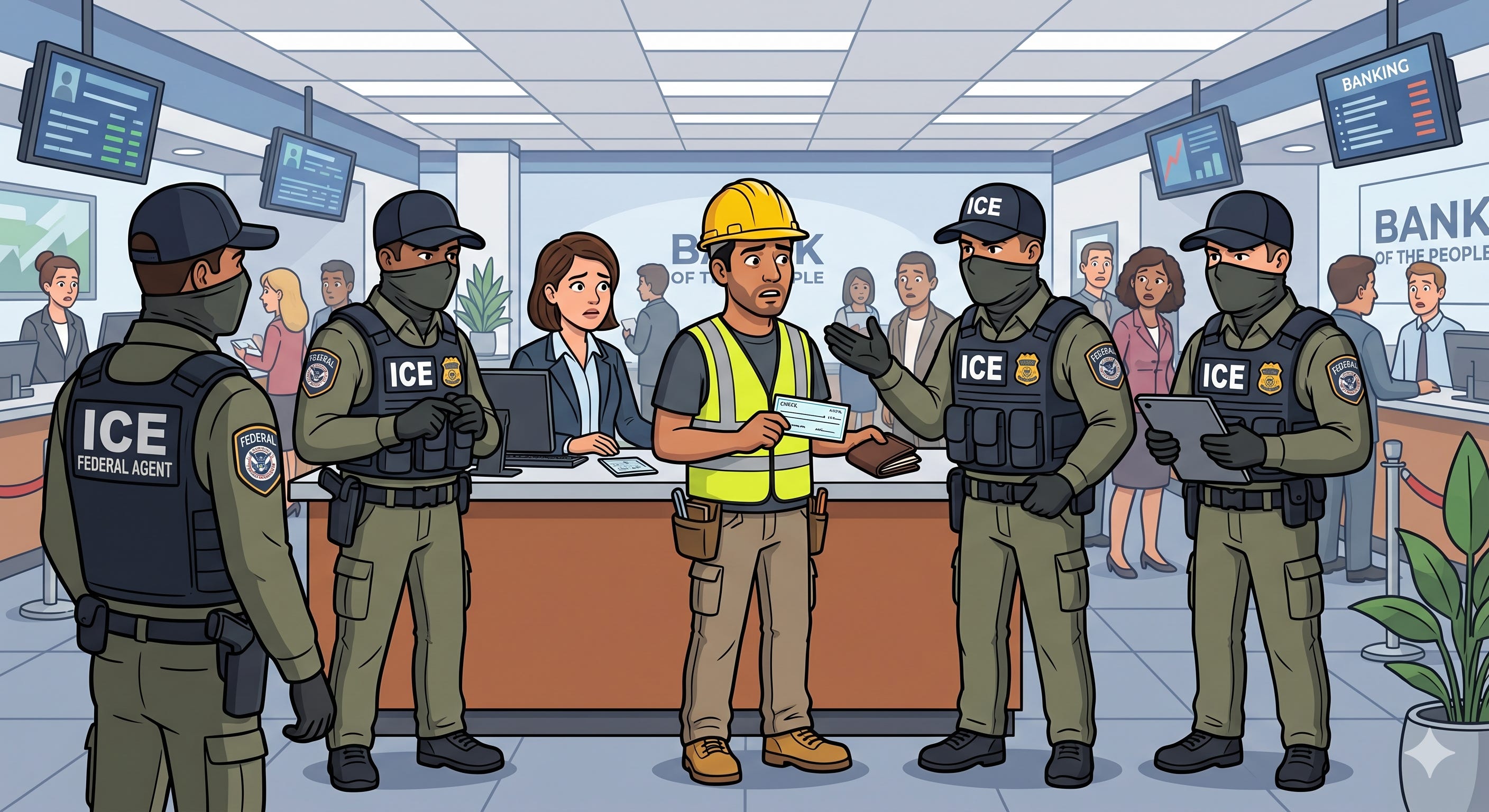
On May 19, 2026, the Trump Administration released Executive Order 14406, titled Restoring Integrity to America's Financial System. This Executive Order formally instructed the Secretary of the Treasury to coordinate with federal financial regulators and issue a direct advisory outlining financial "red flags" to banks and other financial entities. Below are the results.
It is important to realize that the 18 indicators listed below are part of an advisory, not a law. They are warning signs and examples meant to help banks monitor account activity, rather than final legal dictates for account holders. Actual, binding regulatory changes—such as formal revisions to the Bank Secrecy Act to permanently adjust Customer Due Diligence (CDD) and Customer Identification Program (CIP) requirements—are due 60 days following the publication of the Executive Order (by mid-July 2026).
1. Mismatched Social Security Administration Records
“Uses an SSN that, upon verification, does not match or is inconsistent with the SSA’s records;”
Potential Example: An undocumented worker obtains a Social Security Number from a third party to gain employment at a restaurant. When they use that same number to apply for a personal bank account or auto loan, the bank runs an automated background check and discovers the name linked to the SSN belongs to someone else, flagging the account for identity fraud.
2. Shell Business Modeling with High Cash Turnaround
“Opens an account using a non-U.S. passport or ITIN claiming to be self-employed or operating a small business in the agriculture, construction, domestic service, hospitality, or staffing industries and is receiving a significant amount and volume of recurring check deposits from multiple companies before either making a significant and repetitive amount of structured cash withdrawals or issuing low-dollar checks to multiple individuals;”
Potential Example: An undocumented individual sets up an independent house-cleaning or landscaping service using their foreign passport. They deposit large checks from various commercial clients into the account but regularly withdraw the money in physical cash increments of $9,000 to distribute cash wages to their crew, inadvertently matching the exact transactional profile of an illegal shell-company payroll processor.
3. High Volume Corporate Check Cashing
“Cashes a significant volume of checks drawn on accounts owned by companies in the agriculture, construction, domestic service, hospitality, or staffing industries on a recurring basis at an MSB, including a check cashier;”
Potential Example: An undocumented worker handles various day-labor and odd jobs, such as doing weekend demolition for a construction firm, cleaning rooms for a hospitality vendor, and helping a local commercial landscaping crew. Because they do not have a traditional bank account, they receive separate corporate checks from these different companies each week. When they take this collection of multiple corporate checks to the same local check-cashing business or money services business (MSB) week after week, the high physical volume of separate corporate industry checks being processed by a single individual flags them under the system's recurring labor fraud filters.
4. Frequent Peer-to-Peer Incoming Transfers
“Receives recurring P2P payments from a small, recently established company in the agriculture, construction, domestic service, hospitality, or staffing industries;”
Potential Example: An undocumented worker is hired by a newly opened local catering business. Rather than receiving formal paystubs, the worker receives their weekly wages digitally via standard peer-to-peer mobile apps (like Venmo or Zelle) directly from the owner’s account, which alerts the bank to off-the-books commercial labor tracking.
5. Purely Remittance-Based ITIN Account Profiles
“Works in the agriculture, construction, domestic service, hospitality, or staffing industries and opens a bank account with an ITIN with little to no transactional activity besides remittances to foreign jurisdictions;”
Potential Example: An undocumented farmworker opens a basic checking account using an Individual Taxpayer Identification Number (ITIN). They never use a debit card for local retail, gas, or grocery shopping, and instead utilize the account exclusively to deposit cash wages and instantly wire 100% of the funds back to family members abroad.
6. Commercial Mailbox Addresses for Onboarding
“Opens an account for a company in the agriculture, construction, domestic service, hospitality, or staffing industries and is attempting to use a Commercial Mail Receiving Agency instead of a business address;”
Potential Example: An undocumented entrepreneur starts a small painting business and attempts to open a corporate bank account. Lacking a formal commercial lease and wanting to keep their residential address private due to their immigration status, they use a rented box at a local shipping center (like a UPS Store) as their official business address, triggering a standard compliance flag.
7. Sudden Industry Entrants Utilizing Foreign IDs
“Possesses no known prior involvement in the agriculture, construction, domestic service, hospitality, or staffing industries and provides a non-U.S. passport or ITIN as a form of identification when opening an account for a new company in those industries;”
Potential Example: An undocumented individual who has no established corporate tracking in the United States presents a foreign passport to open a commercial account for a newly formed corporate agricultural supply firm, causing the institution to flag the transaction due to a lack of local industry history.
8. Explicit Payroll Claims Flanked by Atypical Volumes
“Makes statements as the account holder or company representative to bank tellers or check cashers that the purpose of the cash withdrawals, negotiation of checks for cash, or check cashing activity is for payroll and the volume, amount, and frequency of transactions are uncharacteristic for a company in agriculture, construction, domestic service, hospitality, or staffing industries with a small number of employees;”
Potential Example: An undocumented supervisor managing a small roofing team withdraws $30,000 in cash from a commercial branch. When the bank teller asks about the purpose of the large transaction, the supervisor honestly replies that it is “to pay my workers for the week,” causing the teller to flag the behavior as an indicator of an off-the-books unrecorded payroll system.
9. Recorded Compliance History Violations
“Has been identified by ICE worksite enforcement news releases and open-source reporting that the customer has a history of worksite compliance violations from ICE;”
Potential Example: An undocumented worker continues to look for work with a major regional agriculture supplier. Because this employer was previously audited or raided by immigration authorities, any financial accounts, corporate payments, or checks linked to this business are heavily scrutinized by the banking system.
10. Large Scale Transacting Devoid of Traditional Payroll Records
“Has significant business operations and transactional activity but with little to no payroll activity commensurate to the customer’s profile;”
Potential Example: A large hospitality venue hires an entirely undocumented kitchen and cleaning crew through an informal word-of-mouth system. The restaurant brings in millions of dollars in card transactions, but its bank logs show zero electronic payroll or direct deposits going out to an actual workforce, indicating hidden labor.
11. Low Ratio Tax Filings Compared to Operations Scale
“Is making Federal and state payroll tax deposits that are significantly less than what would be expected based on their business operations and associated workforce size;”
Potential Example: A large commercial construction firm utilizes dozens of undocumented laborers. To hide them from tax authorities, the company submits tax deposits that match only the salaries of its three main office managers, leaving the manual laborers exposed to sudden worksite compliance checks due to the company’s lopsided tax-to-operation ratio.
12. Heavy Check Generation to Blank Corporate Profiles
“Is issuing a significant and repetitive amount of checks to a singular or small number of recently established companies with little to no online presence;”
Potential Example: An undocumented foreman forms a small LLC to secure sub-contracts from large developers. The large developer routinely cuts massive checks to this new corporate entity, but because the LLC has no website, public footprint, or established digital identity, the developer’s bank flags the outgoing payments as high-risk shell activity.
13. Minimalist Insurance Underwriting Allocations
“Recently acquired a workers’ compensation policy for a small number of workers that is not commensurate with their customer profile and transactional activity;”
Potential Example: A corporate commercial cleaning enterprise actively employs fifty undocumented field staff but purchases a bare-minimum workers’ compensation policy that legally covers only a few individuals. This drastic mismatch in required workplace liability coverage alerts the bank to structural insurance and labor fraud.
14. Inexperienced Ownership with Prior Conviction Profiles
“With beneficial owners that have no known prior involvement with, or in, the company or these industries and may have prior fraud convictions;”
Potential Example: An undocumented crew leader partners with a U.S. citizen to serve as the legal “owner” of a new framing business. If that partner has a history of unrelated financial issues or fraud, the bank’s background sweep will flag the small business entity entirely, putting the undocumented laborers’ payroll account access in jeopardy.
15. Inactive Corporate Tax Footprints Despite Positive Revenues
“With minimal to no history of tax- or payroll-related payments to the IRS, state and local tax authorities, or a third-party payroll company despite a large volume of deposits from clients;”
Potential Example: An undocumented independent contractor runs a small staffing business, collecting regular commercial deposits from corporate clients into a business account. Because they distribute cash directly to their workers and have not set up federal tax withholding systems, the account displays a high-volume income stream with zero outbound tax or formal payroll processor records.
16. Bulky, Monitored, or Transported Cash Actions
“That conducts large or unusual volumes of cash withdrawals or negotiation of checks for cash when accompanied by another involved person(s) or using an armored car service to deliver bulk cash (i.e., conducting informal or off-the-books payroll);”
Potential Example: An undocumented subcontractor goes into a local bank branch every week accompanied by a third-party broker or a supervisor to cash multi-thousand-dollar business checks. The act of systematically extracting physical bulk cash with a regular companion alerts the bank to an organized, unrecorded off-the-books cash distribution system.
17. High Volumes of Low-Value Disbursed Checks
“That is issuing recurring, large volumes of checks for under $1,000 that are made payable to a significant number of separate individuals who cash the checks; and/or”
Potential Example: A small landscaping business operated by an undocumented manager pays its crew by issuing numerous small checks for $450 each week. Because many of these workers are also undocumented and do not have bank accounts, they all systematically take these low-dollar checks to the exact same check-cashing depot, triggering an automated red flag across both financial entities.
18. New Entities Fitting Shell Company Frameworks
“That is a new customer (i.e., less than two years old) with minimal to no online presence and has indicators of being a shell company.”
Potential Example: An undocumented worker establishes a small domestic service LLC to operate legally under commercial guidelines. Because the business is less than a year old, lacks a digital advertising profile, has no active website, and handles large financial shifts through its initial accounts, the bank treats the business as a possible shell company created to move illicit funds.
Conclusion
In summary, the 18 red flags outlined by the federal agencies serve as risk management tools for banks to detect unauthorized employment, identity theft, and off-the-books payroll structures. While these indicators instruct financial institutions to apply enhanced due diligence to riskier accounts, they are not statutory prohibitions. For members of the immigrant community navigating the financial system carefully prior to the implementation of the formal regulatory changes over the summer is vital to preserving long-term banking access.
Sources
Financial Crimes Enforcement Network (FinCEN), Joint Advisory on Non-Work Authorized Populations and Their Employers and Risks to the Integrity of the U.S. Financial System, FIN-2026-A002 (Pages 10–11).
Executive Office of the President, Executive Order 14406: Restoring Integrity to America’s Financial System, 91 FR 30479 (May 19, 2026).